Inner Conflict Explained: Why You Feel Torn Between Two Versions of Yourself (Parts Work & Inner Conflict).
Why You Feel Stuck Between Two Versions of Yourself
Many people feel stuck between two versions of themselves, wanting opposite things at the same time. This inner conflict is not a sign that something is wrong, but a natural expression of different parts within the psyche. In this article, we explore these inner tensions through parts work, Jungian psychology, and archetypal understanding, to make sense of why we feel divided and how we can move toward integration and inner alignment.Signs You Are Experiencing Inner Conflict
Inner conflict often shows up in subtle but persistent ways:
Feeling stuck or unable to make decisions
Wanting opposite things at the same time
Starting something and then pulling back
Feeling both desire and fear toward the same situation
Experiencing emotional exhaustion from “overthinking”
These are not signs of failure, but signals that different parts of you are trying to be heard.

The Inner Tug-of-War: When Opposites Live Within Us
Each of us carries, in different ways and to different degrees, polar opposite energies that can feel like they are in constant tension. These parts may seem to have separate agendas, pulling us in different directions, leaving us torn, confused, and questioning who we really are. This is not dysfunction. It is part of being human. One example is the longing for connection. We may crave deep partnership, intimacy, love, and the safety of family life. Yet, at the very same time, another part of us resists. It fears feeling trapped, longs for independence, and seeks freedom and exploration without ties.
And the paradox is that when we finally experience that freedom, another pull often emerges, a desire for closeness, stability, and belonging. This back-and-forth can leave us wondering: What do I really want? Another common polarity is the desire to be seen versus the urge to hide. We may feel a deep calling to express ourselves, to step into visibility and share our gifts. Yet almost immediately, another part recoils, afraid of judgment, criticism, or failure. So we oscillate between exposure and protection, between wanting recognition and seeking safety. We can also feel torn between control and surrender. One part of us tries to control outcomes, people, and situations, believing that safety depends on it. Another part longs to let go, to trust life, and to relax into what is.
Living between these two states can feel exhausting, but both parts are trying to serve the same purpose: protection. And then there is the tension between ambition and rest. We may feel driven to achieve, to move forward, to prove ourselves. At the same time, another part of us longs for stillness, softness, and space to simply be. One pulls us toward productivity, the other toward restoration, and often we swing between the two without learning how to hold both.
Signs You Are Experiencing Inner Conflict
Inner conflict often shows up in subtle but persistent ways:
Feeling stuck or unable to make decisions
Wanting opposite things at the same time
Starting something and then pulling back
Feeling both desire and fear toward the same situation
Experiencing emotional exhaustion from overthinking
These are not signs of failure.
They are signals that different parts of you are trying to be heard, understood, and integrated.
I have been researching Jungian psychological types, which describe how our psyche is structured around core orientations such as thinking, feeling, sensation, and intuition. These orientations are the primary ways we perceive, interpret, and respond to the world around us.
Thinking and feeling, for example, are ways we make judgments, thinking through logic and analysis, or feeling through values and emotional resonance. Sensation and intuition describe how we gather information: sensation grounds us in the tangible and concrete, noticing details and facts, while intuition attunes us to patterns, possibilities, and the unseen currents of life.
Jung also emphasised that these functions interact with attitudes like introversion and extraversion, which influence where we direct our energy, toward the inner world of reflection, imagination, and personal meaning, or outward toward action, engagement, and social interaction. The interplay of these functions and attitudes creates the foundation of our unique personality, shaping how we think, feel, make decisions, and connect with others.
What I find most compelling is how these types reveal the inner polarities we all carry. Within us, the same energies that help us navigate life also create tension when opposing forces emerge. Jung emphasized that every dominant function has its opposite, and this is where much of our internal tension, and potential growth, lives.
Rational types:
Thinking (Pensiero): Typically logical, pragmatic, and solution-oriented. These individuals value proof, facts, and practical outcomes, often struggling to tolerate or process emotional states. In relationships, their love is expressed through action, they may not verbalise it often, but their presence and reliability demonstrate it. Conflict can arise when thinking types are paired with feeling types, who operate primarily from emotional resonance rather than logic.
Feeling (Sentimento): Relational and emotionally attuned, feeling types often seek connection and discussion of emotions. They thrive in groups and relationships that nurture them. Their love is often expressive and passionate, though it can be fleeting or intense, requiring conscious grounding to avoid instability but may lack reasoning and tools to support objective or neutral perspective.

Irrational types:
Sensation (Sensazione): Individuals attuned to the tangible world, detail, beauty and harmony. Often gifted in creating beauty and appreciating aesthetic balance, they make decisions from experience and feeling rather than logic. They make choices based on “what feels and looks good”. They can be extremely precise and explanatory, which can feel tedious to intuitive types who want to grasp concepts quickly. Sensation types may struggle to integrate intuition, but they offer grounding and richness to any environment they inhabit.
Intuition (Intuizione): Focused on possibilities, patterns, and future potentials. Highly imaginative and abstract, intuitive types can find detailed, concrete tasks or excessive explanation boring or draining. Their challenge is to integrate sensation to balance visionary ideas with practical grounding but also to develop patience and understanding that certain tasks require time and in depth exploration.
Signs You Are Experiencing Inner Conflict
Inner conflict often shows up in subtle but persistent ways:
Feeling stuck or unable to make decisions
Wanting opposite things at the same time
Starting something and then pulling back
Feeling both desire and fear toward the same situation
Experiencing emotional exhaustion from “overthinking”
These are not signs of failure, but signals that different parts of you are trying to be heard.
“Bliss and joy come in moments of living our highest truth, moments when what we do is consistent with our archetypal depths. It’s when we are most authentic and trusting, and feel that whatever we are doing, which can be quite ordinary, is nonetheless sacred.”
Jean Shinoda Bolen Perspective
This perspective was beautifully expanded by Jean Shinoda Bolen in her books Goddesses in Every Woman and Gods in Every Man. Bolen reframed archetypes as living psychological forces: for both women and man, each archetype offers unique gifts and challenges. Typically, we have two or three of these archetypes active in our conscious awareness, while the others remain in the unconscious, subtly influencing our behaviors, emotions, and decisions. Because of this, we may find it challenging to relate to or integrate archetypes that are polar opposites to our dominant ones.
Furthermore, these gods and goddesses can express themselves in ways that are either dependent or independent: some may manifest through relational bonds, thriving in connection and mutual influence, while others operate from a place of autonomy, guided by their inner authority and self-direction. Understanding which archetypes dominate and which lie dormant, and how they relate to dependence or independence—offers a deeper insight into our patterns, choices, and relationships.
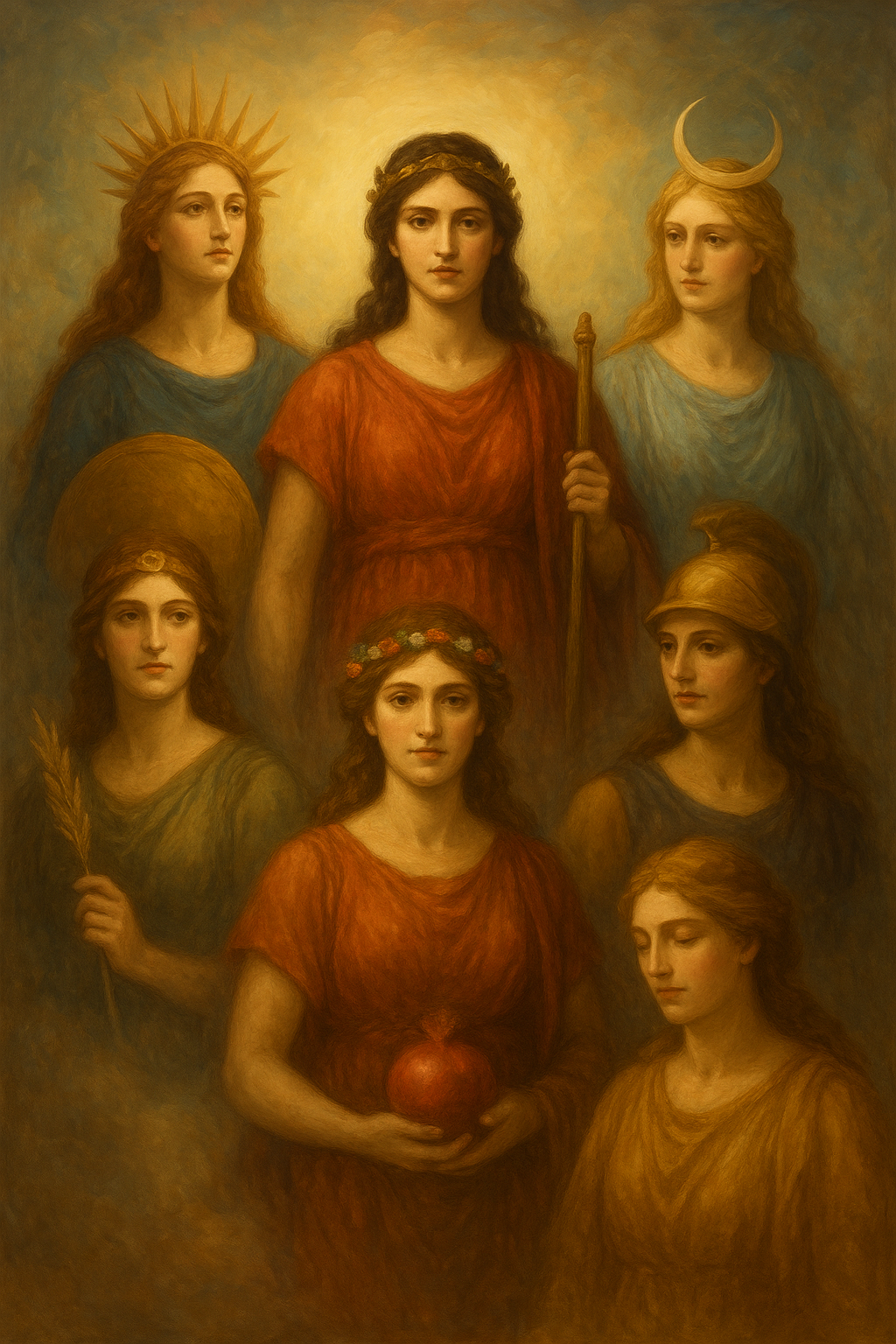
Female Goddess
Artemis, the independent huntress, brings courage, self-reliance, and a fierce protection of personal boundaries, though her shadow can show up as isolation, emotional distance, or fear of dependence.
Demeter, the nurturing mother, offers deep compassion, loyalty, and care for others, yet can slip into overprotection, possessiveness, or self-sacrifice.
Hestia, the hearth keeper, embodies calm, stability, and devotion to home and sacred spaces, while her shadow may manifest as passivity, withdrawal, or neglecting her own needs.
Athena, the wise strategist, shines with intelligence, problem-solving, and moral clarity, but can struggle with perfectionism, emotional detachment, or authoritarian tendencies.
Hera, the queen and protector of sacred bonds, stands for loyalty, commitment, and dignity, though jealousy, control, and resistance to change may shadow her strength.
Aphrodite, the lover, radiates sensuality, creativity, and joy, yet her shadow may bring manipulation, codependency, or over-identification with appearance and desire. Finally,
Persephone, the transformative maiden, embodies resilience, depth, and the courage to face darkness, while her shadow can emerge as withdrawal, victimhood, or emotional repression. Together, these goddesses illuminate the full spectrum of feminine energy, reminding us that embracing both our light and shadow is the path to true wholeness.
Male Goddess
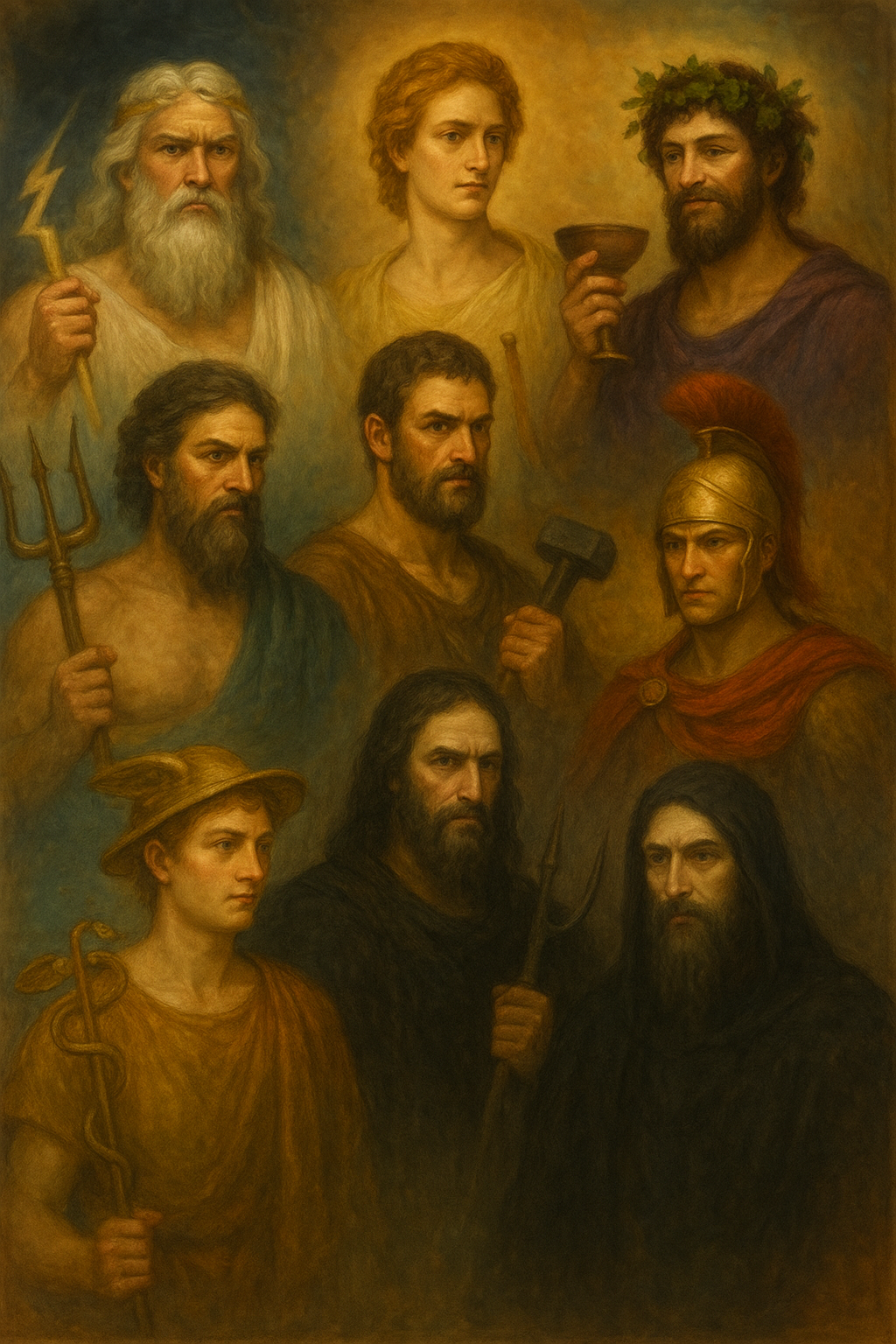
For men, archetypes such Zeus – The Ruler, embodies authority, leadership, and the drive to control and organize. He is visionary and decisive, often taking responsibility for the welfare of others. In his shadow, Zeus can become domineering, tyrannical, or overbearing, using power to maintain control rather than to inspire.
Apollo – The Thinker, represents intellect, reason, and clarity. He seeks order, knowledge, and truth, excelling in analysis, communication, and planning. When unbalanced, Apollo can become rigid, emotionally distant, or obsessed with perfection and logic at the expense of feeling.
Dionysus – The Ecstatic One, channels passion, creativity, and liberation. He thrives on emotional expression, spontaneity, and deep connection to the body and senses. His shadow side can manifest as impulsivity, excess, addiction, or destructive pleasure-seeking.
Poseidon – The Seeker of Depth, embodies emotional depth, intuition, and the power of the unconscious. He is attuned to the unseen currents of life and often drawn to spiritual or creative exploration. In imbalance, Poseidon may become moody, secretive, or emotionally overwhelming.
Hephaestus – The Builder and Craftsman. is the archetype of skill, perseverance, and creation. He turns raw materials into tools, art, or solutions, representing the power of diligence and transformation. When shadowed, Hephaestus can be overly focused on work, perfectionist, or socially withdrawn.
Ares/Mars – The Warrior, embodies courage, action, and the willingness to fight for one’s principles. He thrives on challenge, conflict, and physical strength. In his shadow, Ares can be aggressive, reckless, or driven by anger and domination rather than purpose.
Hermes – The Messenger, represents communication, adaptability, and the gift of connecting ideas, people, and experiences. He is playful, quick-witted, and curious. Shadow Hermes can be manipulative, deceitful, or inconsistent, using cleverness to evade responsibility.
Hades/Pluto – The Transformer, governs transformation, boundaries, and the power of the underworld within. He teaches about death, endings, and the necessity of letting go, facilitating deep psychological growth. When unbalanced, Hades may become controlling, secretive, or morbidly fixated on power and loss.
My Journey: Understanding Archetypal Energies
What I’ve learned is the importance of curiosity and acceptance toward these contrasting energies. Without curiosity, we risk condemning, being unconsciously led by, suppressing, or avoiding parts of ourselves that are essential and may need support, space and guidance.
The first invitation is always to pause and investigate with curiosity about the force that lives within you, whatever its nature, even if it brings challenges, or discomfort.
The second step is reflecting on how we express/suppress/displace these energies in life. For example, I may feel a strong maternal or nurturing energy. Yet, if I misdirect this energy toward people who do not need it, or if it creates codependency in a relationship, it causes tension and frustration. The same energy, properly aligned, to people who truly need support or in contexts where care is welcomed, can flow healthily and constructively.
Understanding polar opposite forces within ourselves is an act of awareness that helps us realign these energies to the right spaces, relationships, and contexts. Otherwise, these parts can take over unexpectedly, creating confusion and dysfunctional dynamics we would rather avoid. The key takeaway is that every energy within us has value. By observing, understanding, and consciously directing it, we can live more harmoniously with ourselves and others, and avoid unintended consequences from unrecognised forces. Awareness allows us to integrate our polar opposites, honour their needs, and find the spaces where their expression is both safe and enriching.
Resources to Explore:
Psychological Types – Carl Jung
Goddesses in Every Woman – Jean Shinoda Bolen
Why do I feel like I have two versions of myself?
Feeling like you have two versions of yourself is often a result of inner conflict between different psychological parts. These parts may have opposing needs, such as safety versus freedom, or connection versus independence, creating tension within the mind and body.
What is parts work in psychology?
Parts work is a therapeutic approach that understands the psyche as made up of different parts or sub-personalities. Each part has its own role, intention, and protective function, even when it creates conflict.
How do you resolve inner conflict?
Inner conflict is resolved not by choosing one side, but by understanding and integrating both parts. This involves awareness, emotional regulation, and learning how each part contributes to your overall psychological balance.
If this resonates with your experience, I offer trauma-informed somatic counselling in Brighton and online, supporting people to move from reactive relational patterns to embodied, authentic connection. You’re welcome to book a free discovery call to explore working together.